
Alabama Financial Literacy Statistics
The Alabama Financial Educators Council (AFEC) conducts research to assess the level of financial wellness among residents across the Yellowhammer State. The findings are routinely refreshed and published on this page to ensure accuracy and relevance. Policymakers, educators, community groups, and advocates are welcome to use these data to inform financial literacy initiatives, legislative efforts, and implementation of existing legislation. Advancing the financial wellness mission statewide remains the Council’s primary focus.
Cost of Financial Illiteracy Survey
Alabamians report that lack of financial knowledge carries a high cost, according to the NFEC’s most recent survey. Participants across the state responded to the single question: “During the past year, about how much money do you think you lost because you lacked knowledge about personal finances?” The results are shown below. Since 2017, the NFEC has conducted this annual survey, consistently revealing that the average individual cost of financial illiteracy approaches or exceeds $1,000 per person – with estimated national losses reaching into the hundreds of billions of dollars each year, and losses in the hundreds of millions across Alabama.
Cost of Financial Illiteracy
$0 – $499
$500 – $999
$1,000 – $2,499
$2,500 – $9,999
$10,000 +
Financial Vulnerability in Alabama
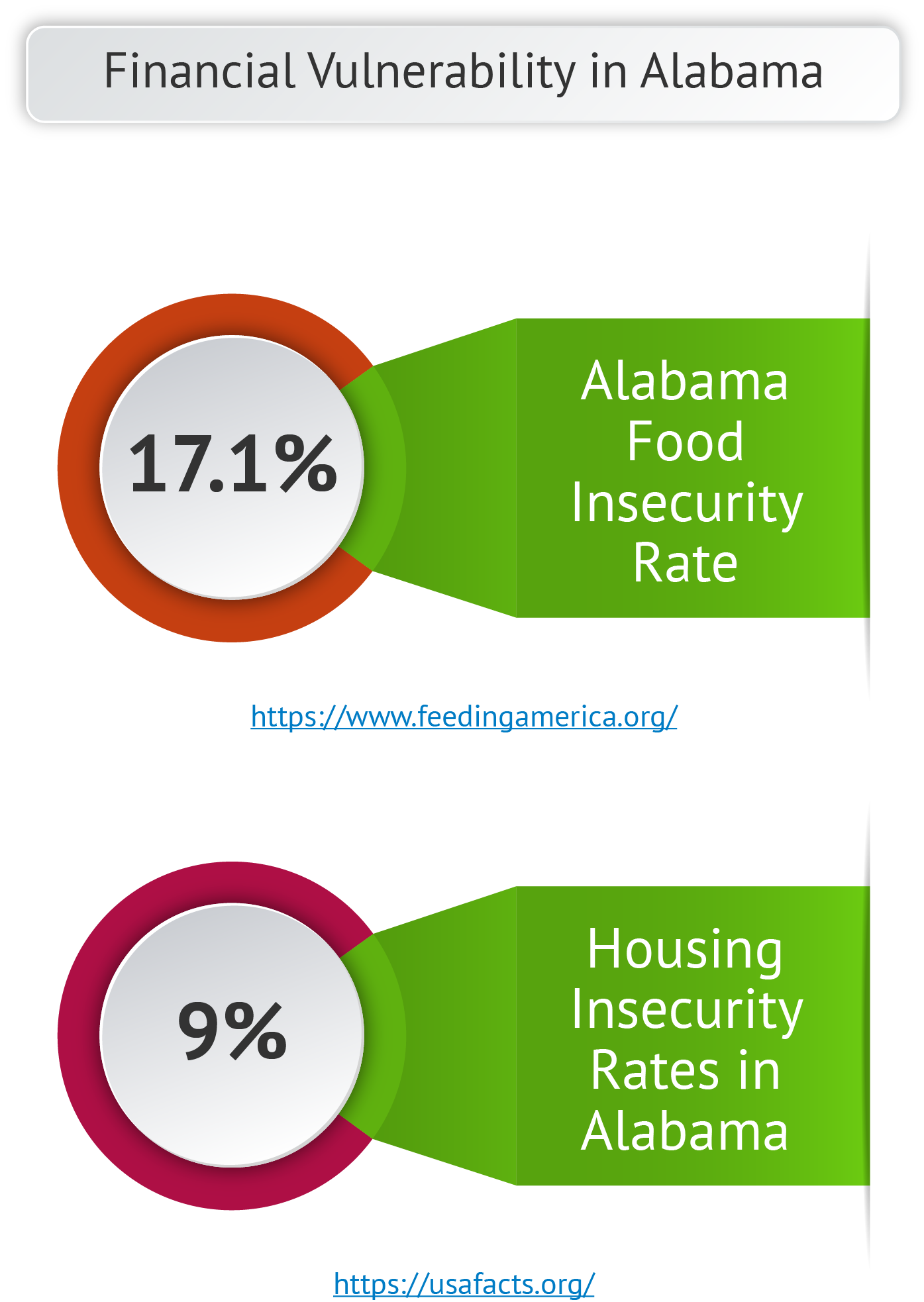
Two important metrics indicate the levels of financial vulnerability in U.S. states: housing insecurity and food insecurity. Regarding food insecurity in Alabama, Feeding America reports that 1 in every 6 people (a total 896,510, 17.1% of the state population) faces hunger in the state, and 250,580 of those individuals are children. The federal SNAP program administered in Alabama indicates that among the households receiving supplemental nutritional benefits, 47.6% have children.
The housing insecurity rate in Alabama was 9.0% in data reported in 2024 by the World Population Review (WPR). That estimate translates to a total homeless population of 4,601 that year, a decrease of 15.6% since 2007. The WPR lists the leading four causes of homelessness as lack of affordable housing, unemployment, poverty, and low wages.
The Financial Situation in Alabama
Debt Load Rates
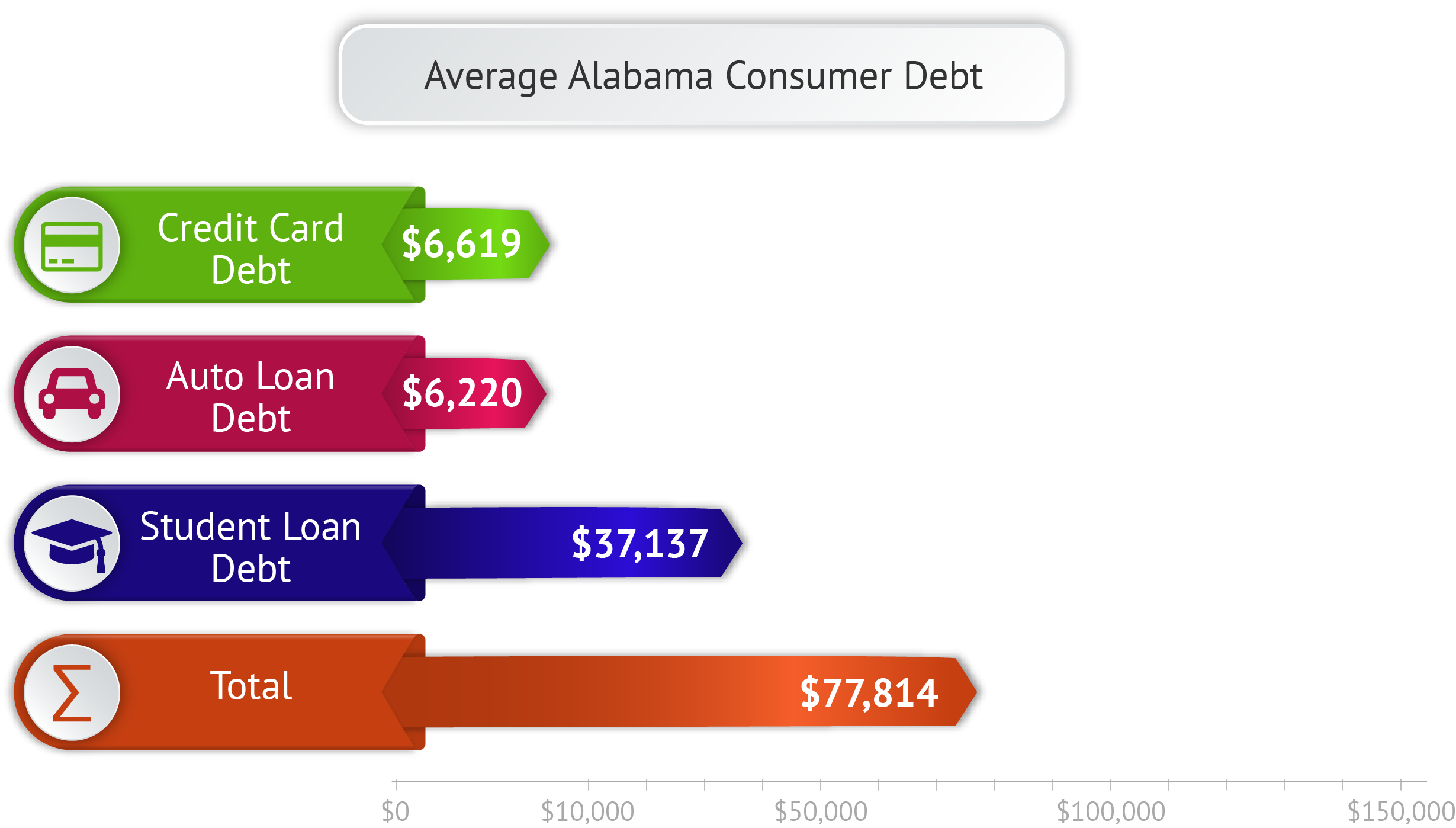
In the Yellowhammer State, data from Experian showed that the average consumer debt per household was $77,814 in 2025. While that figure is substantially lower than the U.S. average that year of $104,755, debt per household still remains high in Alabama.
Debt Load Averages by Type
Student debt remains a substantial problem across the country, and Alabama is no exception: among Alabamans with student loans, the average balance is $37,137 according to the World Population Review. WalletHub indicates that average debt carried on credit cards is $6,619 per user in the state; and WPR reports that Alabamans with auto loans owe an average of $6,220 on those loans.
Alabama Financial Literacy Legislative & Educational Statistics
The National Education Association (NEA) carries out research to clarify educational statistics by U.S. state, including number of public school districts, student enrollment data, and number of teachers serving those students. In its most recent report (2025), the NEA shows that Alabama had 150 total school districts in the 2023-24 school year and a total student enrollment of 726,735. Teachers in those districts numbered 45,213, for a pupil-to-teacher ratio of 16.1:1.
Standards related to school financial literacy education have been on the Alabama books since 2012, when the State Board of Education adopted the following resolution: “Replace the Computer Application .5 unit requirement for high school graduation with a .5 unit of Personal Finance/Financial Literacy that can serve as a CTE Course.” This mandate applied beginning with the graduating class of 2017. In May 2023 HB164 was signed into law, requiring that high school students entering ninth grade in the 2024-2025 academic year complete a standalone personal finance and money management course before graduation. The bill also requires establishment of a financial literacy examination and reporting of the examination’s summary results to the State Department of Education.